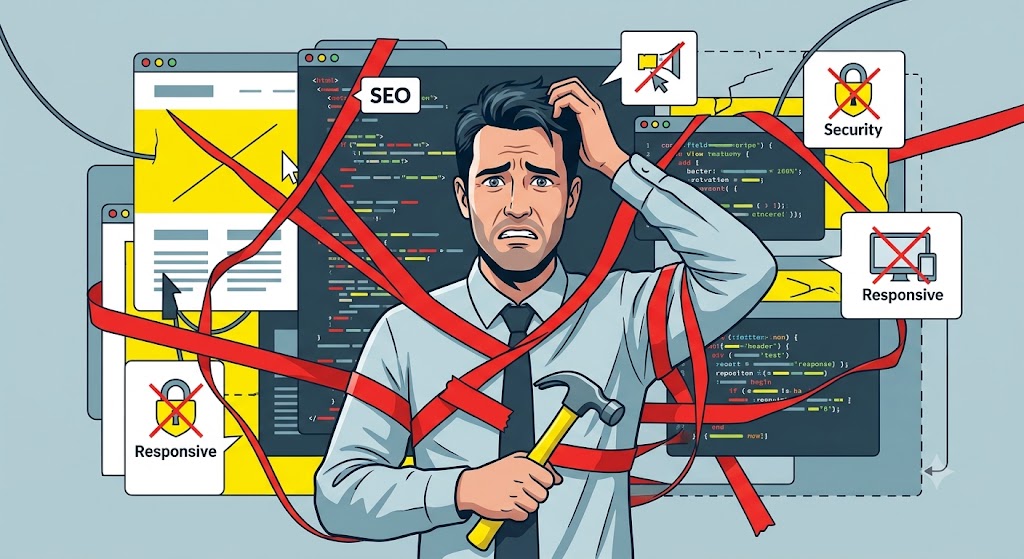
As a business owner, you are used to wearing a lot of hats. You’re the CEO, the project manager, the customer service rep, and occasionally the janitor. When it’s time to get your business online, it’s incredibly tempting to add “web designer” to that list and try to DIY a site over a weekend using a generic page builder.
It looks easy on the commercials. But for most tradesmen and service professionals, the DIY route quickly turns into a massive time-sink that delivers frustrating results.
Let’s look at why the DIY web design trap happens, and why outsourcing it is actually the most cost-effective decision you can make.
1. Your Time is Worth More Than a Template
Let’s do some quick math. If you spend 20 to 30 hours wrestling with layout grids, trying to get images to align, and figuring out why your mobile menu won’t open, that is time taken directly away from your actual business.
Those are hours you could have spent bidding on high-value contracts, finishing client projects, or spending time with your family. When you calculate your actual hourly worth, a “free” or cheap DIY website builder suddenly becomes incredibly expensive.
2. The “Looks Okay on My Computer” Illusion
A common trap with DIY builders is that the site might look decent on the specific laptop you used to build it. But the moment a customer opens it on an older iPhone, a tablet, or a different web browser, the layout shatters.
Professional web development isn’t just about making a pretty screen; it’s about writing clean, responsive CSS code that forces the layout to adapt flawlessly to every screen size, device, and browser automatically.
3. Missing the Hidden Essentials (SEO & Security)
A website is completely useless if it sits on page 5 of Google results. DIY platforms often genericize your settings, leaving you with:
- Poor keyword density that doesn’t target local clients.
- Missing or unoptimized meta descriptions.
- Broken URL structures and lack of proper domain redirects.
Worse yet, without proper security configurations and clean optimization, DIY sites are highly susceptible to plugin bloat, slow loading speeds, and security vulnerabilities.
Stick to Your Craft. We’ll Handle the Code.
You didn’t start your business to spend your weekends debugging database errors or adjusting image compression rates. You started it to be an expert in your trade.
At Rad Website Design, we handle the technical heavy lifting—from pristine WordPress development to rock-solid local SEO setup—so you can stay focused on what actually makes you money.
Ready to take web design off your to-do list? Drop us a line today, and let’s build a professional digital platform that does the heavy lifting for you.
Leave a Reply